 (zur deutschen Version hier klicken)
You can use the more secure ssl protocol to read these pages: https://www.sunorbit.net
(zur deutschen Version hier klicken)
If there would have been any further need for a proof of the contents of this site Tau Ceti now delivered the all important proof: this star, which is only 12 light years away from us has been the target of one of the earliest searches for extraterrestrial life in the 60ths and 70ths, but astronomers couldn't find any hints of orbiting planets in the 60s through 90s. A shortly completed re-examination, which especially considered the wobbling of the central star discovered five potential planets ranging from two to nearly seven times the mass of Earth, with orbits ranging from 14 to 640 Earth days long.
But the most exciting fact about this news is, that this discovery was made by purely reanalysing the old data, no new data was won. And mathematics hasn't changed a bit since the sixtieth of last century. Only the new knowledge about wobbling stars led to the discovery of these exoplanets. Two of these planets could potentially be the closest habitable exoplanets yet discovered. So we will likely see soon many new discoveries on many more earlier examined stars.
More info here: http://www.newscientist.com/article/dn23021-nearby-tau-ceti-may-host-two-planets-suited-to-life.html?cmpid=RSS|NSNS|2012-GLOBAL|astrobiology

Visitors to this site come from all countries in this world as the two logs below show (under .com and .net you find companies of the whole world, the extremely low visitor count from japan may be due to actual problems (atom disaster) in japan, Australia is in these logs underrepresented.compared to other logs). An extremely low visitor count on weekends (esp.sundays: 700 page views typically, compared to 5000-8000 hits on weekdays, this means 2000-3000 page views on weekdays) is an indicator of mostly professional visitors (search engines etc. not counted!). Btw this means more than 2 mio hits per year! Again search engines, archives etc not counted. And since this site is cached in many provider/proxy/etc. caches world wide (which is evident by the cache updates of big providers/proxies etc) you can multiply these numbers by the count of big providers and other caches world wide.
Head hunters should note the enormous intellectual potential of the ancient soviet republic.
Under "unknown domain" you find mostly people which visit this site with anonymising proxies (scientific institutions which don't want to be listed etc..). With ixquick you have even the option to visit all internet pages per proxy!
And then: nearly 70% of the visitors to this site bookmark this site! And revisit this site regularely to see whats new. And an incredible 50% load down the whole site with massdownloaders (perhaps I should offer a downloadable pdf...).
While the normal visitor count rather steadily increases the visitor count from european and US- universities nearly doubles every month in the end of 2011.
On some days up to 20% of all visitors come from universities (there are very few sites in the net with that many visitors from universities. And in this case most of the european universities are even not counted ):
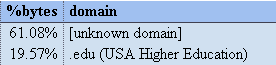

and a rather constant amount of US-military personal visits these pages nearly every other day and notes every little change (modern military eqipment is very sensitive to particles from solar storms!):

UC Berkeley's A. Filipenko presented in the history channel documentary: "The Universe: Mars The new evidence" the here first postulated hypothesis "Mars lost his moon(s)" as the latest - although still quite controversial - theory on the history of mars. And since this site presents a coherent theory it is not possible to take just one part of the theory proposed here. So it is likely that this is the first step of acceptance of this theory in whole.
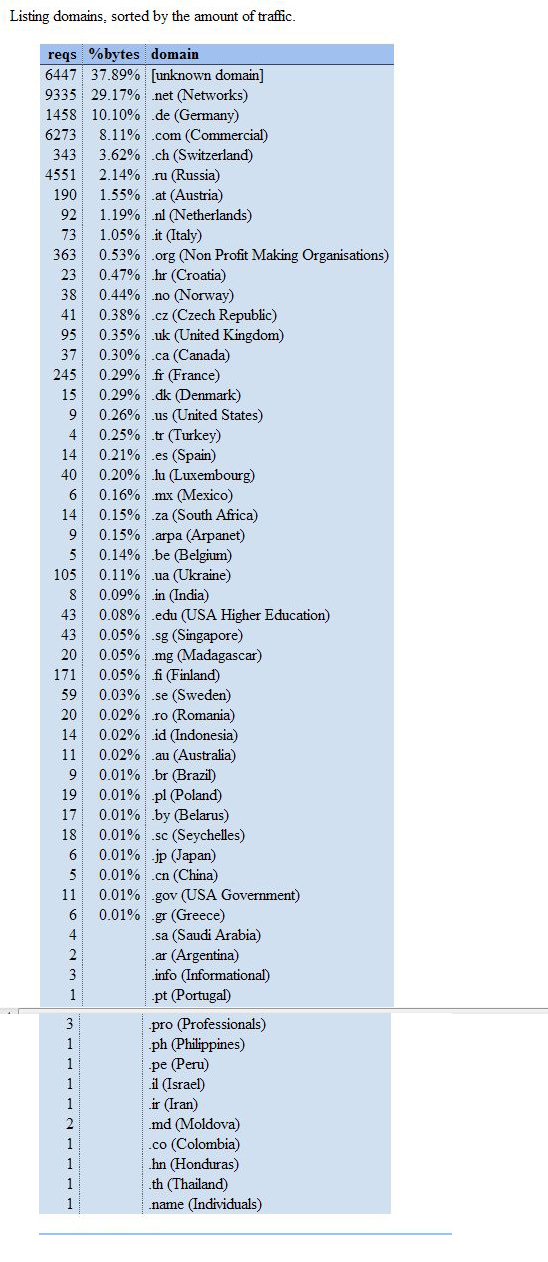
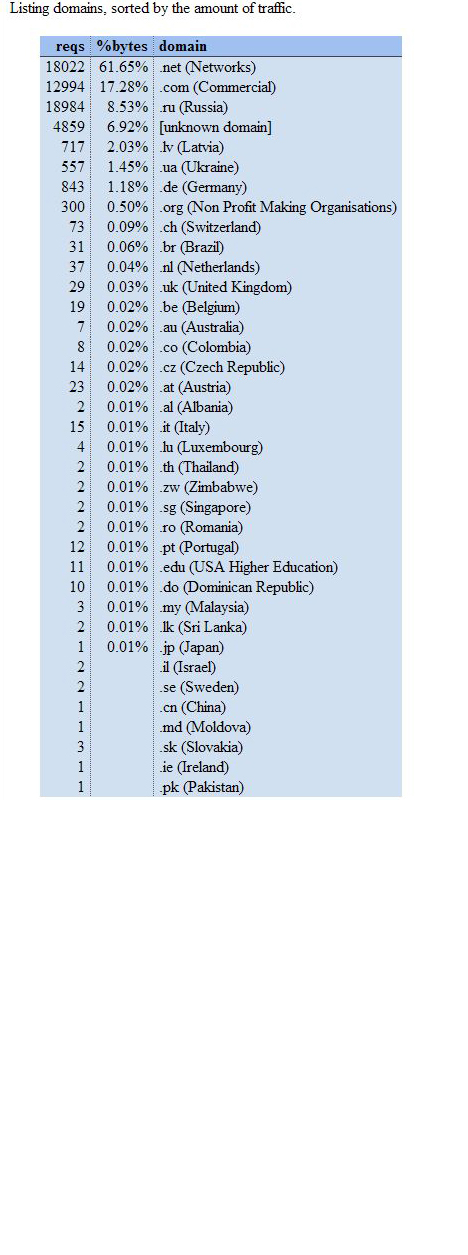
Visitors are coming in 2018 from more than 100 countries in this world (unknown domain are anonymizers, invalid ip's, Tor users etc..):
Listing domains, sorted by the amount of traffic.
| reqs | %bytes | domain |
|---|---|---|
| 32155 | 44.20% | [unknown domain] |
| 30557 | 23.27% | .com (Commercial) |
| 13447 | 18.78% | .net (Networks) |
| 5140 | 1.36% | .de (Germany) |
| 277 | 1.35% | .ca (Canada) |
| 220 | 1.34% | .us (United States) |
| 182 | 0.85% | .in (India) |
| 171 | 0.74% | .pl (Poland) |
| 223 | 0.71% | .org (Non Profit Making Organisations) |
| 268 | 0.69% | .it (Italy) |
| 101 | 0.58% | .uk (United Kingdom) |
| 1528 | 0.55% | .ru (Russia) |
| 83 | 0.48% | .edu (USA Higher Education) |
| 136 | 0.46% | .au (Australia) |
| 170 | 0.34% | .mx (Mexico) |
| 61 | 0.23% | .fr (France) |
| 60 | 0.18% | .se (Sweden) |
| 94 | 0.18% | .br (Brazil) |
| 51 | 0.17% | .ae (United Arab Emirates) |
| 37 | 0.14% | .ph (Philippines) |
| 29 | 0.13% | .ie (Ireland) |
| 29 | 0.12% | .za (South Africa) |
| 38 | 0.12% | .il (Israel) |
| 30 | 0.12% | .tr (Turkey) |
| 1019 | 0.11% | .cz (Czech Republic) |
| 25 | 0.11% | .sg (Singapore) |
| 44 | 0.10% | .th (Thailand) |
| 43 | 0.10% | .pt (Portugal) |
| 30 | 0.10% | .kz (Kazakhstan) |
| 101 | 0.10% | .at (Austria) |
| 142 | 0.09% | .nl (Netherlands) |
| 99 | 0.09% | .ch (Switzerland) |
| 11 | 0.09% | .gy (Guyana) |
| 19 | 0.08% | .id (Indonesia) |
| 32 | 0.08% | .fi (Finland) |
| 282 | 0.07% | .ua (Ukraine) |
| 23 | 0.07% | .be (Belgium) |
| 22 | 0.07% | .pk (Pakistan) |
| 30 | 0.06% | .no (Norway) |
| 20 | 0.06% | .arpa (Arpanet) |
| 329 | 0.06% | .tk (Tokelau) |
| 9 | 0.06% | .dk (Denmark) |
| 21 | 0.06% | .jp (Japan) |
| 26 | 0.06% | .lt (Lithuania) |
| 7 | 0.05% | .gov (USA Government) |
| 9 | 0.05% | .co (Colombia) |
| 11 | 0.05% | .lk (Sri Lanka) |
| 16 | 0.05% | .nz (New Zealand) |
| 10 | 0.05% | .ec (Ecuador) |
| 18 | 0.04% | .gr (Greece) |
| 29 | 0.04% | .hu (Hungary) |
| 6 | 0.04% | .bg (Bulgaria) |
| 7 | 0.04% | .vn (Vietnam) |
| 27 | 0.04% | .ro (Romania) |
| 10 | 0.04% | .my (Malaysia) |
| 6 | 0.03% | .ge (Georgia) |
| 14 | 0.03% | .es (Spain) |
| 3 | 0.03% | .pg (Papua New Guinea) |
| 72 | 0.03% | .hr (Croatia) |
| 5 | 0.03% | .gt (Guatemala) |
| 4 | 0.02% | .ke (Kenya) |
| 4 | 0.02% | .bh (Bahrain) |
| 3 | 0.02% | .jo (Jordan) |
| 3 | 0.02% | .zw (Zimbabwe) |
| 10 | 0.02% | .md (Moldova) |
| 4 | 0.02% | .bd (Bangladesh) |
| 4 | 0.02% | .kg (Kyrgyzstan) |
| 21 | 0.02% | .is (Iceland) |
| 3 | 0.02% | .cy (Cyprus) |
| 22 | 0.02% | .ly (Libya) |
| 16 | 0.02% | .ar (Argentina) |
| 7 | 0.02% | .tv (Tuvalu) |
| 105 | 0.02% | .cn (China) |
| 5 | 0.02% | .ir (Iran) |
| 6 | 0.02% | .om (Oman) |
| 7 | 0.02% | .ws (Samoa) |
| 3 | 0.02% | .bm (Bermuda) |
| 2 | 0.02% | .mil (USA Military) |
| 2 | 0.02% | .gh (Ghana) |
| 6 | 0.02% | .biz (Businesses) |
| 44 | 0.02% | .sk (Slovakia) |
| 3 | 0.02% | .am (Armenia) |
| 2 | 0.02% | .mk (Macedonia (Former Yugoslav Republic)) |
| 2 | 0.02% | .hn (Honduras) |
| 3 | 0.01% | .bn (Brunei Darussalam) |
| 4 | 0.01% | .cl (Chile) |
| 2 | 0.01% | .ba (Bosnia-Herzegovina) |
| 2 | 0.01% | .sa (Saudi Arabia) |
| 2 | 0.01% | .ni (Nicaragua) |
| 2 | 0.01% | .np (Nepal) |
| 1 | 0.01% | .cm (Cameroon) |
| 1 | 0.01% | .cr (Costa Rica) |
| 1 | 0.01% | .kr (South Korea) |
| 1 | 0.01% | .ky (Cayman Islands) |
| 1 | 0.01% | .info (Informational) |
| 1 | 0.01% | .tj (Tajikistan) |
| 1 | 0.01% | .lv (Latvia) |
| 1 | 0.01% | .ma (Morocco) |
| 1 | 0.01% | .uz (Uzbekistan) |
| 1 | 0.01% | .vi (Virgin Islands (USA)) |
| 1 | 0.01% | .pe (Peru) |
| 1 | 0.01% | .aw (Aruba) |
| 1 | 0.01% | .az (Azerbaijan) |
| 2 | 0.01% | .hk (Hong Kong) |
| 12 | .io (British Indian Ocean Territory) | |
| 22 | .by (Belarus) | |
| 7 | [unresolved numerical addresses] | |
| 3 | .do (Dominican Republic) | |
| 13 | .lu (Luxembourg) | |
| 2 | .ee (Estonia) | |
| 1 | .uy (Uruguay) | |
| 2 | .lb (Lebanon) | |
| 1 | .tw (Taiwan) | |
| 1 | .kh (Cambodia) | |
| 1 | .ps (Occupied Palestinian Territory) | |
| 1 | .ag (Antigua and Barbuda) | |
| 1 | .ci (Ivory Coast) | |
| 1 | .ml (Mali) | |
| 1 | .pm (Saint Pierre and Miquelon) | |
| 1 | .sh (Saint Helena) | |
| 1 | .bj (Benin) |
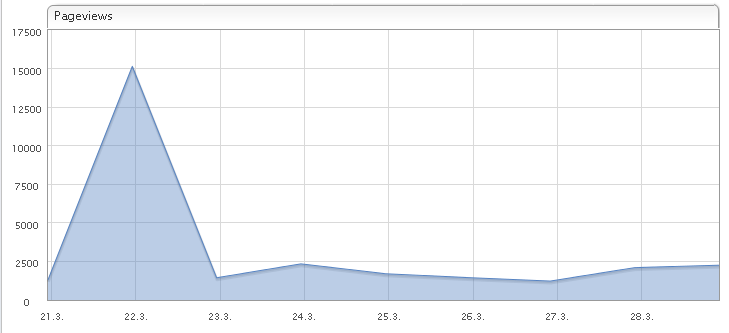
Average day of january (around 2000 page views, just for the Seo pages that report an average of 3 visitors per day for this site. And for Seos which are not really firm in primary school math this means 60.000 page views a month and nearly one million page views a year. )
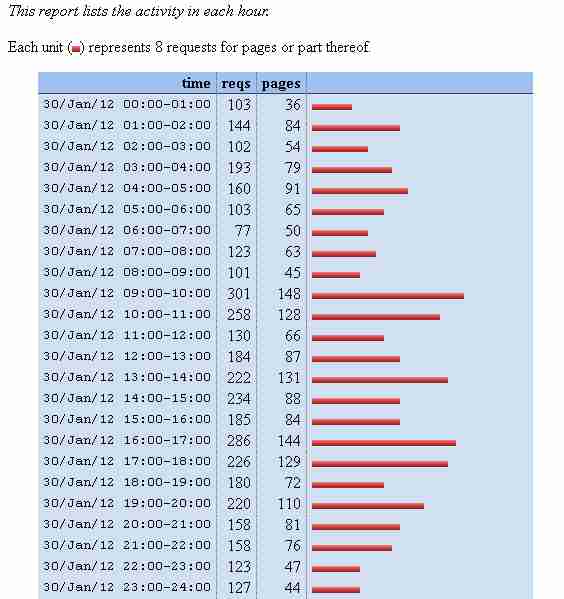
Pageviews over one full week (the peeks are due to new page uploads etc):
Preface: it is near to impossible to fake screen shots!
In January 2012 Google found one million backlinks to this site (Google.com 1.050 mio Google.de 1.070mio.
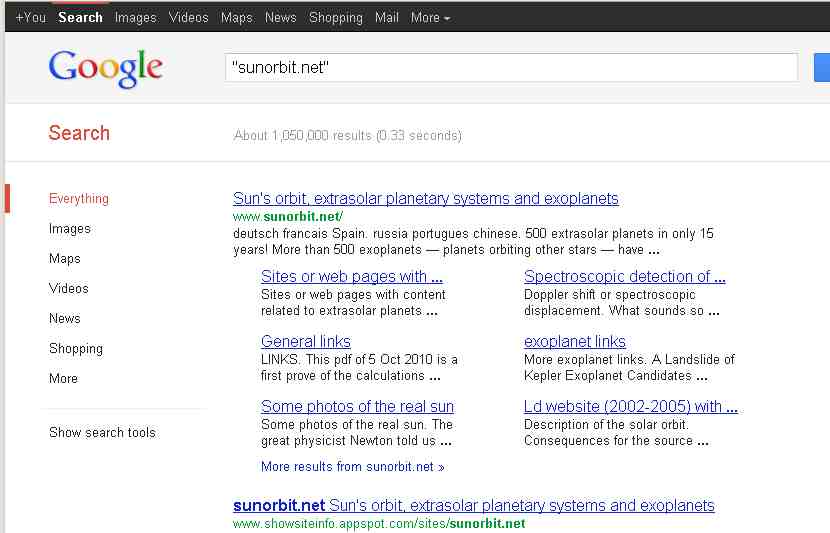
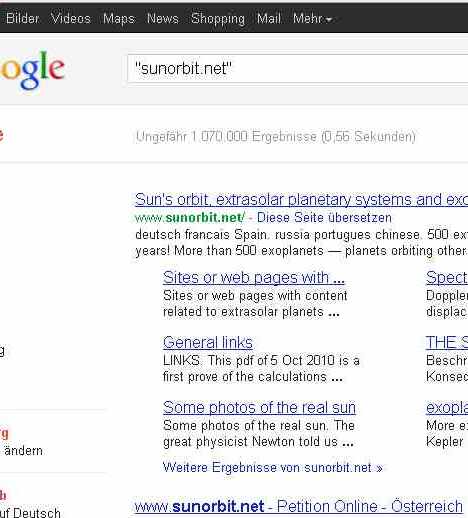
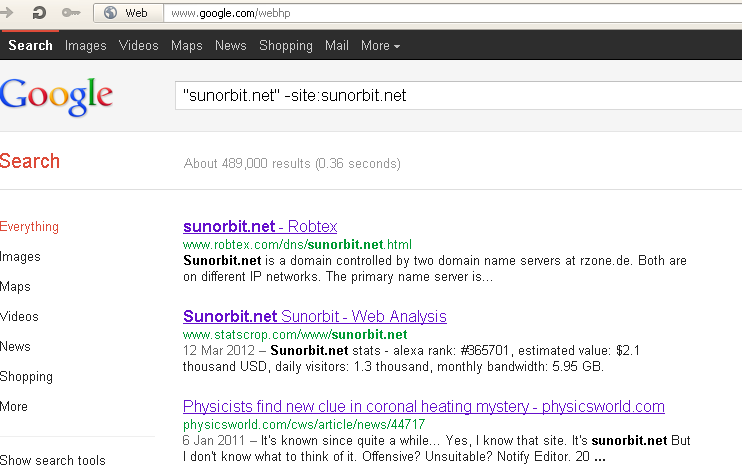
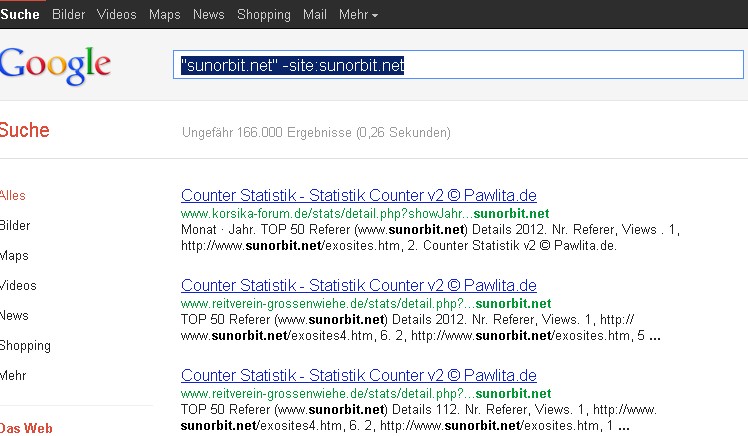
Normally this would reflect in a much higher ranking of this site. If you want to test it by yourself: search for "sunorbit.net" in quotes. You get a list of all pages on which sunorbit.net is mentioned. Don't wonder if all relevant lnks come on the last pages. Out of some strange reason Google likes in this case to reverse its sort algorithm. And if you want to see the links that Google doesn't show use any other (independant!) search engine. Fortunately there are still some few that don't depend on Google's results.).
And since quite a while Google likes to play the dirty game of showing on the first page of the search results a much lower results count than on the 4th or 5ths page. This can be sometimes as low as 1/10 of the real search results, so that innocent Seo's which only look on the first page get a totally wrong impression. These two screenshots were taken just one second apart on 2.of April 2012.
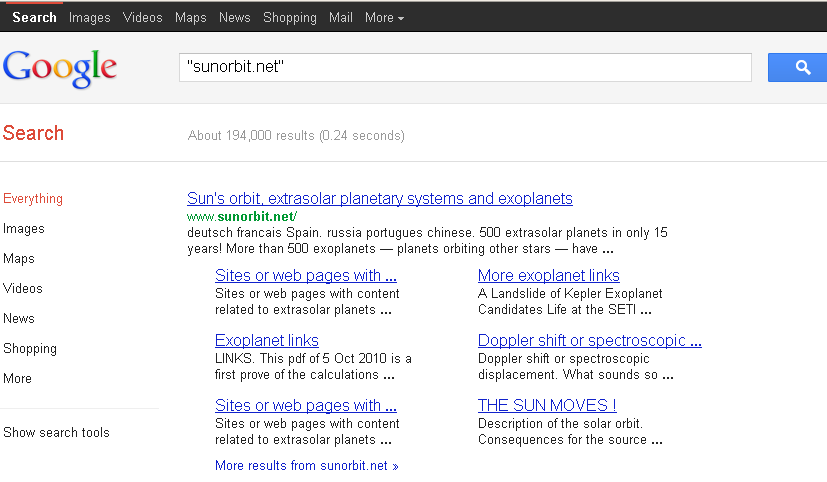

This is what Google showed on 8. of April 2012: who is right , Google.com or Google.de? Or none of them? .
(Please note: these 2 screenshots were taken some days after the other screenshots on this page were published. As you can see Google was right in the transition phase of switching back to a normal sort order - but the links of blekko.com below Google has still not found (2 weeks later). While US-Google.com already shows the links almost in the normal sort order - most important links first - Google.de still has the reverse sort order: most irrelevant links first.
If you want to test other search engines etc there are special sites in the net, for instance http://push2check.com/sunorbit.net. where you can get this information. Test for instance the yahoo dir button:
If you want to see links that Google doesn't shows use for example blekko.com - a rather small and unknown search engine, with many links that you won't find in Google Is Google such a bad search engine that they really can't compete with blekko or does Google hides intenionally these links??? And these are not all. I found some really important ones on other search engines! :

Another one - maybe these results are not important - but you won't find these results in Google, why?:
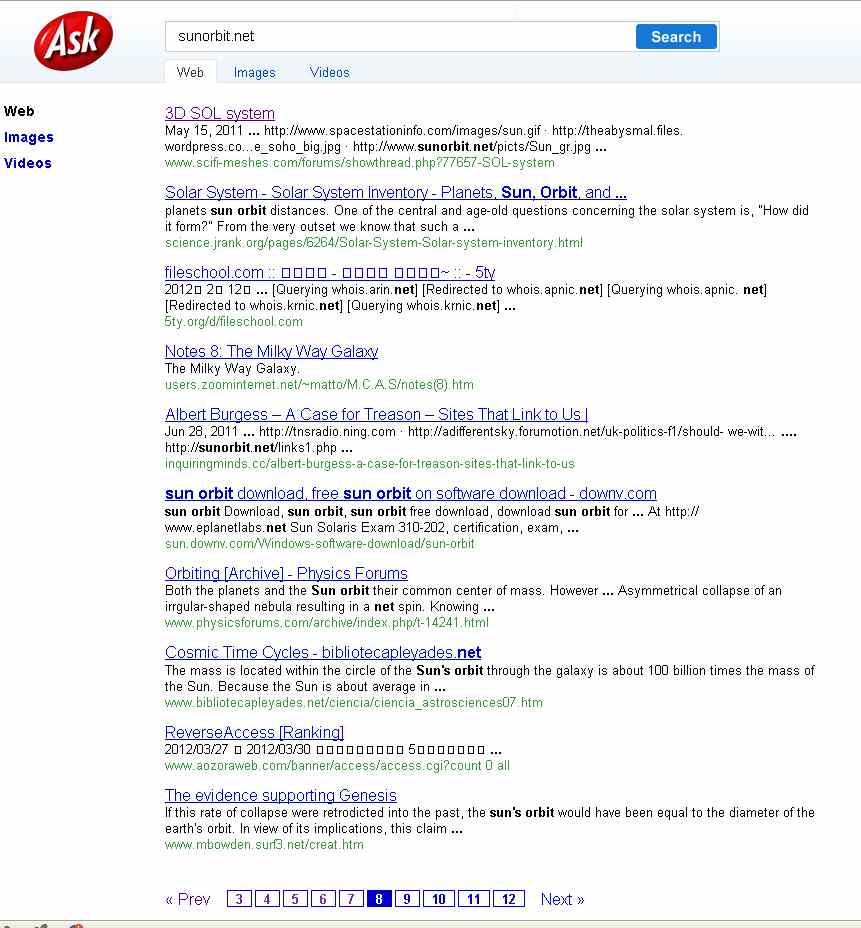
These 2 links Google is absolutely unable to find in the normal search results: Is Google really not able to compete with blekko??
Some more links, so that Google can manually integrate them in their search results (I will upload them by and by so that everyone can follow the integration in Google's search results - till it gets too embarrasing for Google):
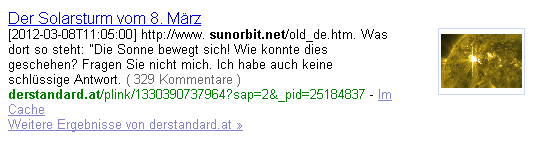
and also the link above from blekko.com Google knows if you explicitely ask for "sunorbit.net" + abovetopsecret.com (but does not show it to you in the normal search results. Why? Does Google has something to hide?):

19.4.12: Congratulations! Google.de found this one and lists it on one of the last pages of the search results! So the following is history: Another one, which will Google only show you if you know it already, same as the link above. It should be clear to anybody that this is not the definition of a search engine! I don't need a search engine to find the links I know! Insert "sunorbit.net" + zeit.de in the search box, then you get this:

and even these excite search results reveal some interesting results, which Google does not show :
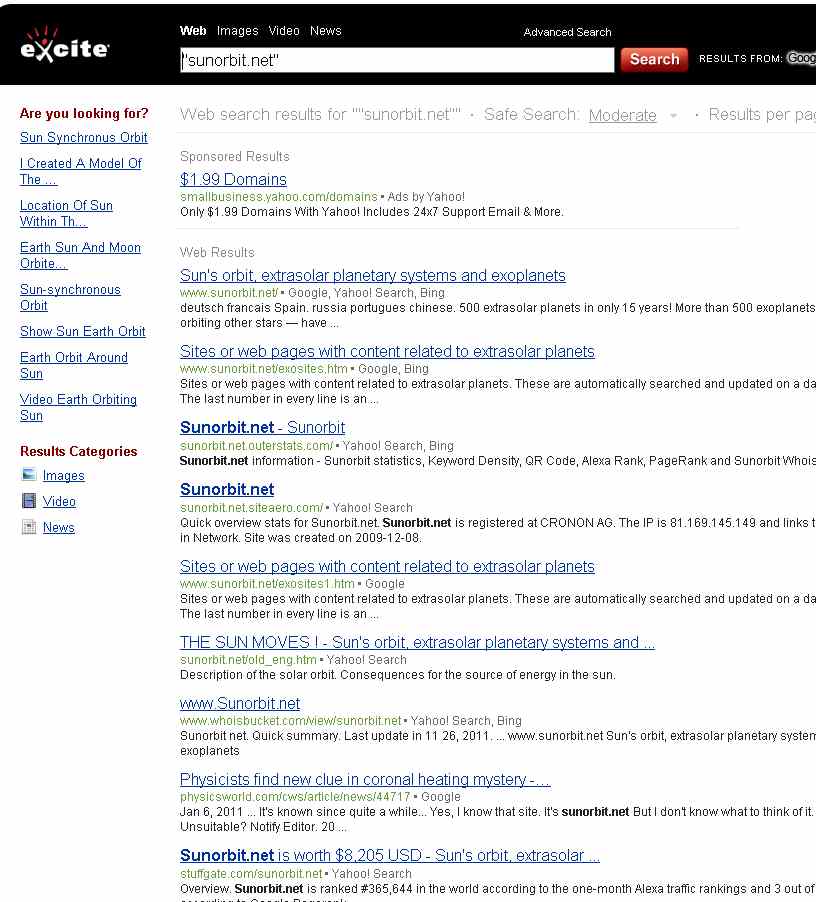
Btw, some of the links above Google found after publishing these results....
On 4th of April 2012 Bing and Yahoo for the first time did sent more visitors than all Google's world wide combined - surely a sensational fact if you know their respective market share. With steadily increasing visitor count !
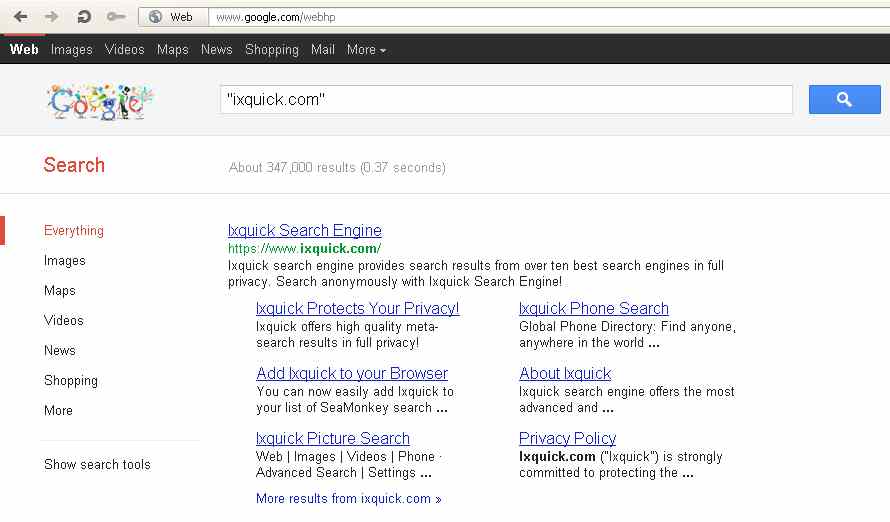
Just for the record, the well known search engine ixquick has less backlinks than this site, only as an example (and in this context you should know that ixquick - as any other site with that many backlinks - has Google pagerank 7 of 10, but sunorbit.net has got only Google pagerank 3 of 10! Strange, isn't it? If you want to test it by yourself go for example here: ) :
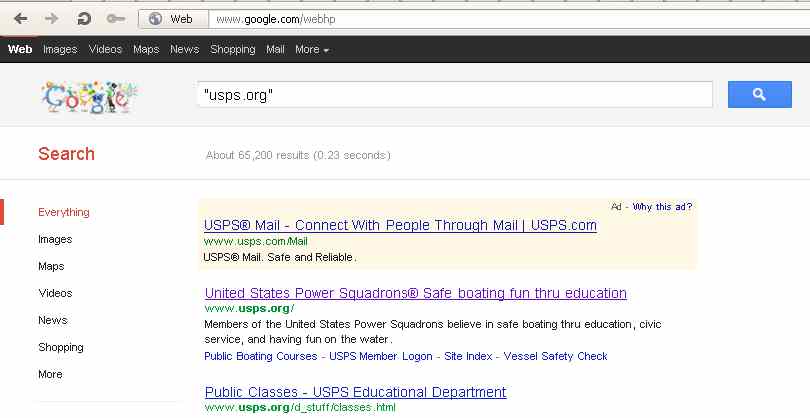
Another example, this time Google pagerank 6 and also lower (much much lower ! nearly 1/20th) backlink count:
History of this site
From my earlier attempts to solve the n-body problem numerically but also from history I knew that there were two prerequisites to fulfill if you wanted to solve this problem: at first accuracy and at second high enough computations per time unit. So this was a typical problem for a 32bit processor with floating point unit.
I had access to computers from the 60ths of last century (the dark ages: punched cards, Fortran or even Assembler. You received one week later a big pile of paper all filled with errors.) till today. I worked with mainframes, Vax'es and PDP's in dark cellars. In those days we spent endless (night-)hours in front of totally uninformative alphanumerical displays (in the beginning even tele-typewriters!). But we already dreamed of the graphical displays that I could help to become real in the 70ths and 80ths. Now a whole new era started, because these displays were under the direct control of the main processor (no terminal as with mainframes and Unix machines) and thus all graphics was now extremely fast. So that you could start writing programs that even with silicon graphics machines (the best graphics machines at that time, but with unix os's ) were not possible. Before that there were only plotters. And plotters don't allow dynamic output, only purely static output was possible. Evolution of terminals see also here.
In the mid-1980s you had the choice between
three 32bit Processors with potential FPU support. Motorolla
68000, National Semiconductor 32032/32332 and Intel 386. All of them
had facts speaking for them and others speaking against. While
the NS processor was clearly the best designed of these three
(very orthogonally) , a lack of software - especially a good C++
compiler - ruled out this processor for the task at hand. If I
remember well the FPU had some minor problems too.
The Motorolla
- as the second best designed - too had a problem mainly with
software, there was no compiler with sufficient accuracy, at
least at acceptable cost. The FPU was also a somewhat weak
point. The Intel (the so called IBM-PC, because IBM selected this
processor out of the three) had for long time a really bad
reputation at computer insiders because the transition from the
8-bit world over 16bit to 32bit was a very
painful process with this processor for programmers. It was over
years one single nightmare. I only cite Sir AndrewTannenbaum
who spoke of a brain-dead
architecture
("brain-dead
nature of the Intel CPUs").
But what spoke in this case for the Intel processor was that its FPU worked
internally not with 64 bits but with 80 bits, an advantage that could be crucial
for this problem. So when in 1985 the first acceptable Intel processor
appeared, the Intel 386, a first version of a program that could simulate our
planetary system was on my agenda. A good compiler was available with the
Zortech V1(later V2/3). But the program was not really usefull, because
although the program worked only in 2d it took ages to calculate even a 2 or 3
body simulation. A downgrade from 'C++' to 'C' was no solution. It was not much
faster. So again I had to wait. The introduction of the FPU which was announced
at the same time as the processor was delayed by 2 years. And when it was
finally available in 1987 it had a lot of bugs (as the other FPU's at that
time also, e.g, problems with infinity ), which made it necessary to write
complicated test software to rule out these errors and write code to avoid the
errors. This again made the program really slow. So essentially not before the
486 in 1989/90 it was possible to write a half way useful
program, because for the required acuracy a FPU was absolutely mandatory. But
now there showed up problems with the vga-cards. Some were extremely slow
(Oak-Cards, WD), some had driver problems (you had to write the drivers by
yourself for higher resolutions..), some had unacceptable limitations. After
long long testing issues the Tseng ET3000 proved acceptable, but was still
slow. Finally in 1991 arrived the ET4000 with acceptable speed, so that
extensive testing of the program was possible. So in mid 91 it was clear
that the program delivered stable results. I had tested a multitude of data from
different sources and there was no doubt on the solar orbit that the program
showed.
One last point should be mentioned which seems to be not understood by many who also tried to solve the problem: the program is a Dos-Program. And under Dos any running program has the whole processor (and FPU!) for its calculations alone. There is no task switcher, no dispatcher, no scheduler, no counters, no services, no background tasks, no indexer, no...... To give you a notion: do a ctrl-alt-del. (You will see around 40 programs running.) Yes, the inner workings of a multi-task/multi-user-system is today for a phycisist or mathematician as essential as has been for centuries the intime knowledge of a slide rule, integral calculus, series expansion, differentiation, matrix/vector calculation..... (I have written a book on it, so it is for me unfair easy to state this). The same is true for the compiler that you use. Although compilers are very mature these days(2009), there are still some trap-doors to fall in. The only drawback in writing a program like this under Dos was that you had to write your 'graphical environment' completely by yourself. And without graphical output such programs are really hard to debug.
I never was very ambitious and had no fear that someone would outwit me, so I told freely all my friends the results the program delivers.
I had during the whole 1980s a study group together with many scientists from DESY, our local large scale accelerator for particle physics research here in Hamburg which works in very tight cooperation and exchange in manpower with the large scale accelerator at CERN in Geneva. They were just then developing for their own accelerator and the accelerator at CERN a 68.000 system for the detectors and my own computer company had developped in the beginning 1980s a Z80/Z800/Z8000 system and a NS16032/32332 system with comparable performance. At those times it was absolutely open who was going to make the race. And since the whole hardware at those times posed with all those ASIC's a lot of timing problems we exchanged our experiences to get around those bugs. The same was true for software, but even worse, there simply was no software for the new processors. You had to start from ground up. This changed a lot in the end - 1980s.
This study groop ended in the late 1980s but I had won some friends there. So it was quite naturally that they were under the first that I informed of the results that my program delivered: that the sun orbits around the gravitational center of our planetary system. "Incredibly, did they really forget to calculate this" was the most heard comment. And since astro physics has not the best reputation under particle physicist (unjustified as you can read on the history of the n-body-problem) I don't repeat the further comments here. So this news spread very quickly in whole DESY and in CERN in Geneva too. Telephone lines turned red hot for some minutes.
But I had also shown to some other friends of mine (all PhD-physicists) the results of my program of which at least one seemed he wanted to get undeserved merits afterwards. So I got to admit that I send my letter to the physics institutes a little bit hasty.
I can't recall for sure when the site sunorbit.net and sunorbit.de were commited under my name. I remembered 2002 but there are links in the net which tell that it already existed in March 2001. It seems that it was even earlier comited, but I can't tell. (Just found the beginning of my sites on my harddisks: it was a homepage on Compuserve and shortly after on AOL in 1998. But the exact content is no more reconstructable.)
The same is true for the abandonment. I think it was in 2006. I gave up all my sites in 2006 because of severe health problems. And then I wanted to try out free providers. It was a desaster. Half of the time my websites were out of reach because of server down times. Search engines don't visit you anymore and you get totally forgotten in the net. This seems to be due to the fact that on these servers a great deal of the websites are not finished, are rudimentary 'under construction' sites with lots of links going to nowhere land and sheer garbage sites. Often even the index is not installed correctly so that these sites look like old ftp-sites from 1990. It seems these free sites are sorted out systematically by search engines. BTW Google has till today not indexed my free sites!
But since my old sites sunorbit.net and sunorbit.de where now taken by someone else, I couldn't change back.
Finally in December 2009 the guys who had occupied my sites gave up and I could take them over again(9.of dec 09).
No more:(see text below) Download the program here: gravity.zip download .dat file
Please be aware that this is no Windows-program! 1990/91 there existed no Windows(or Windows 3.0 which was useful for nothing)! It may function under the Dos-prompt of Windows, but no guarantee given! Be aware that even under Dos there is no guarantee that the program works! When this program was written, the newest VGA-cards were WD Paradise, ET3000 and OAK-cards! There are even some functions which for sure won't work with todays DOS/Windows, because the function-calls have changed (eg the write-comand.) I never reworked the program because I consider it a document.
Please use your own data for the .dat file. The .dat file changed a lot, because very different simulations have been accomplished with the program.
Why the program is no more downloadable?
The program was written in the 1980ths. In the 80ths there simply was no graphical OS (the first versions of Windows in the beginning 90ths were simply crap). The program was written for MS-Dos, for which a good compiler existed. But MS-Dos had no graphical standard defined. So you needed special drivers id you wanted something else than the standard 320x240 resolution of the color cards. These drivers have long disapeared and do no more work under modern OS's. So in 2014 I was tired of the many complains.....
Change in old_eng.htm: On 13.April 2010 I took some of the harsh formulations out of old_eng.htm - without changing the content I hope. In foreign languages it is not always easy to judge the exact meaning of an expression. So it's easy to cross the borders to insulting expressions where you only wanted to make a yoke.
Since the very beginning of this site I have a (in numbers 1) visitor from the wonderfull seychelles: Greetings!
2.8.2010 uploaded the already 2002 announced additional arguments that solar energy results out of the here described forces: global_warming.htm or klimawandel.htm(german)
US-Army got some smart guys. They visit these pages nearly every other day and note every little change ... But also all important US-Universities have visted this site and all important german Universities. And even german military.
This site has a 2:1 relationship of professionals to private users: on weekends the visitor count is much lower than on weekdays .
New site: http://www.exoplanets.4ju.org (or http://www.exoplanets.4uj.org)
New site: http://www.extrasolar-planets.4ju.org (or http://www.extrasolar-planets.4uj.org)
New site: http://www.secondearth.eu
Enlarged the font of some pages, because some people told me they had problems with the eyes and the new 1920x1200 screens.
Most of the (important) links on the links page were found with the oldest technique of the net, which was possible right after the invention of the WEB by CERN in 1991-1994 (Midas,Viola, later Mosaic) and before there existed any search engine: by following links. Some few (1-2) were found after one year or two (!) by googling. This is in the first place due to the ever increasing comercialication of the net (and the obvious and often complained low ranking of science pages in Google). Some I could only find with the aid of the ExositesCrawler. Seems it's high time for a european search engine with an adequate ranking for science pages!
I note since quite some time from my server log files that many internet users surf with very antiquated settings: the browser cache settings of many visitors to this site are still set as usual in modem connection times, which means a big cache. This is antiquated since most internet surfers today are connected via DSL and it means today only a minimal longer load time of html pages if the cache is set to zero. On the negative side it means that many of the visitors of my sites don't see actual pages but pages which are at least one month old if not older. So half of the net (the most actual pages) may pass unseen by many surfers.
As many of you have noted this site can't win any prices what concerns design. Design is not my concern and the site surely looks like that. But the site is designed for speed. Because there are still people with slow connections out there.
Finally....
Apologies for using so many bracketed sentences, but footnotes are not usual in the net
My grandfather once told me that there are two kinds of people:
Those who do the work and those who take the credit.
He told me to try to be in the first group; there was
much less competition.
Indira Gandhi
